

The Indian Sub–Continent
Medieval India
Hindu Shahis of Kabul and Gandhara
Here follows a detailed selection of coins from the Hindu Shahis of Kabul and Gandhara and post-Shahi imitations. The time period covered is from c.750CE to c.1200CE.
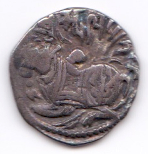
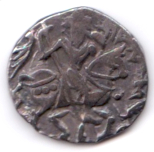
Hindu Shahis, Śri Spalapati Deva, c.750–900CE, AR Jital, (Kabul), Tye 3.1.
Few Shahi coins bear a ruler's name and Spalapati appears to be a title: 'Army–Commander'. The first ruler was called Kallar who was vizier to the last Turkic king of Kabul, whose realm he usurped, and who 'accidentally discovered hidden treasures', presumably the silver deposits in the Panjshir Valley that enabled the Shahi kings to issue a stable silver currency.
General description of Tye type 3:
Obverse: 'Śri Spalapati Deva' in Śāradā script.
The bull Nandi seated left wearing jhul and with trident on rump.
Reverse: Fragmentary inscription top right. Tye suggests it is corrupt Brahmi and may read 'Shahi Deva'.
Horseman riding horse to right holding long staff in right hand with banner at top. Junction between staff and banner is often off flan.
Photos © Angela Grant 2026
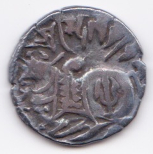
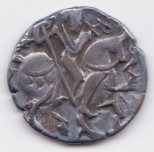
Hindu Shahis, Śri Spalapati Deva, c.750–900CE, AR Jital, (Kabul), Tye 3.2.
The main difference between 3.2 and 3.1 is the patterning of the jhul or cloth on the back of the bull Nandi.
Photos © Angela Grant 2026
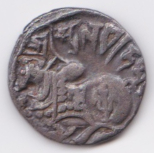
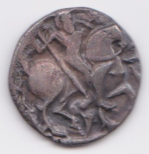
Hindu Shahis, Śri Spalapati Deva, c.750–900CE, AR Jital, (Kabul), Tye 3.-.
Again the difference is in the patterning of the jhul. There is also a letter or symbol under the horse at the base of the staff. This version is not listed by Tye, so is an unpublished variety.
Photos © Angela Grant 2026
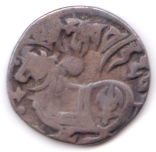
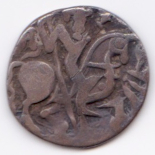
Hindu Shahis, Śri Spalapati Deva, c.750–900CE, AR Jital, (Kabul), Tye 4.2
Type 4 is similar to Type 3, but the Brahmi(?) inscription has deteriorated into a series of angles, and there is a Śāradā letter 'Gu' to left of horseman's head.
Photos © Angela Grant 2026
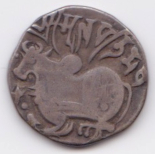
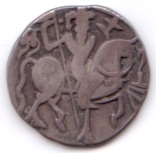
Hindu Shahis, Śri Spalapati Deva, c.750–900CE, AR Jital, (Kabul), Tye 5.1
Type 5 is similar to Type 3, but the Brahmi(?) inscription has deteriorated into a series of angles, and there is a Śāradā letter 'A' to left of horseman's head, and symbol as ⨦ to right.
Photos © Angela Grant 2026
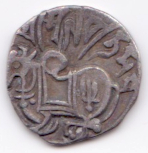
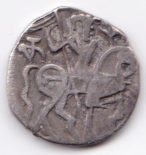
Hindu Shahis, Śri Spalapati Deva, c.750–900CE, AR Jital, (Kabul), Tye 6.1
Type 6 is similar to Type 3, but the Brahmi(?) inscription has deteriorated into a series of angles, and there is a Śāradā letter 'Ka' to left of horseman's head, and symbol as ⨦ to right.
Photos © Angela Grant 2026
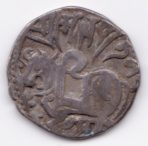
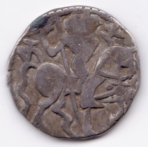
Hindu Shahis, Śri Spalapati Deva, c.750–900CE, AR Jital, (Kabul), Tye 6.1
A second copy of Tye 6.1.
Photos © Angela Grant 2026
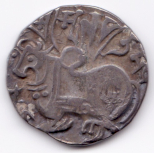
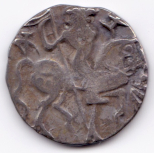
Hindu Shahis, Śri Spalapati Deva, c.750–900CE, AR Jital, (Kabul), Tye 6.1
A third copy of Tye 6.1.
Photos © Angela Grant 2026
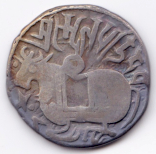
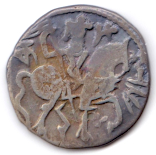
Hindu Shahis, Śri Spalapati Deva, c.750–900CE, AR Jital, (Kabul), Tye 6.2
Tye 6.2 is similar to Tye 6.1 but has, in addition, three dots under the forepart of the horse.
Photos © Angela Grant 2026
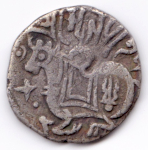
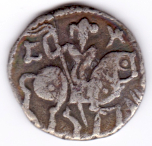
Hindu Shahis, Śri Spalapati Deva, c.750–900CE, AR Jital, (Kabul), Tye 7.1
Type 7 is similar to Type 3, but the Brahmi(?) inscription has deteriorated into a series of angles, and there is a Śāradā letter 'Da' to left of horseman's head, and symbol as ⨦ to right.
Photos © Angela Grant 2026