

The Medieval World
Here follows a selection of coins from the medieval world. The area concerned is Europe, the Mediterranean basin, and adjoining territories extending as far east as the borders of India. The time period covered is from the reform of Anastasius in 498AD to c.1500AD.
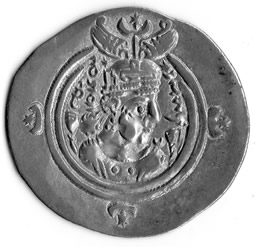
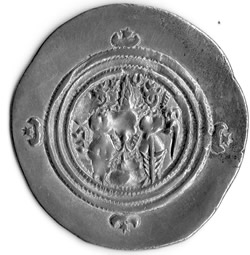
Sassanid Empire of Iran, Khusru III, AD630?, or Khusru V, AD 631?, AR Drachm, Year 2, Kirman mint.
The period between the deposing of Khusru II in 628 and the ascent to the throne of the last Sassanid Yazdegard III in 632 was a very confused one. Civil war brought various relations of Khusru II to the throne for short periods and seldom did any of them control the whole country. Furthermore their exact relationship to Khusru II is at times a little vague. Khusru III may have been a nephew of Khusru II, and Khusru V may have been his son or grandson. The former apparently survived a few months in Khorasan and eastern Iran, and the latter about a month or so at the capital Cstesiphon. This coin, showing a beardless male was thought at first to be of the latter, but now, being from an eastern mint, is thought more likely to be of the former. Whichever is correct, the coin is a very scarce piece.
Photos © Angela Grant 2009-2019
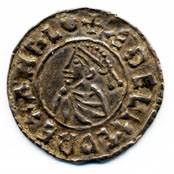
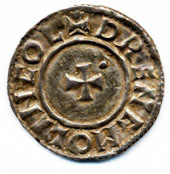
Kingdom of England, AR Penny (late small cross), Aethelred II 'the Redeless', 978-1016, Moneyer: Dreng of Lincoln.
Usually, but not correctly, referred to as 'Aethelred the Unready', a mistranslation of 'unræd' meaning 'ill-advised'. He came to the throne under the cloud of the murder of his brother, Edward the Martyr, and his kingdom was harried by repeated attacks by the Danes, who were bought off by the payment of tribute or 'danegeld'. His reign ended in a war against Sweyn Forkbeard, the Danish king, and Cnut, Sweyn's successor, Cnut being the final victor, uniting the Crowns of England and Denmark.
Photos © Angela Grant 2013-2015
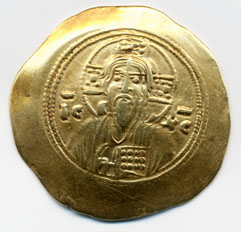
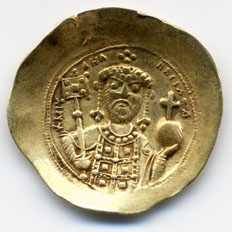
Byzantine Empire, Michael VII Doukas, 1071-1078, AV Histamenon Nomisma, Class II.
Michael was born c.1050, the eldest son of Constantine X and his wife Eudokia. He should have gained the throne on his father's death in 1067, but showed little interest in politics and his mother and her new husband Romanos IV took control of the state. When Romanos was captured by the Seljuks in 1071, Michael was raised to the throne by his uncle John Doukas assisted by his tutor, whist his mother was packed off to a monastery. As an emperor Michael proved disastrous. Militarily incapable, he allowed the empire to lose Bari, its last stronghold in Italy, to the Normans, areas of Anatolia to the Seljuk Turks, and was faced with an attempt by the Bulgarians to resurrect their former state in the Balkans. Financially he was equally incompetent, and his devaluation of the currency led him to be awarded the nickname Parapinakes (minus a quarter). He was finally removed by revolts of his army commanders in both the Balkans and Anatolia, and allowed to retire to a monastery. He later became Metropolitan of Ephesus, and died c.1090.
Photos © Angela Grant 2013-2017.
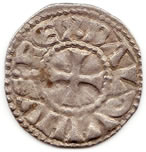
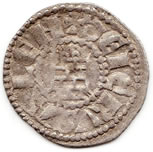
Kingdom of Jerusalem, Baldwin III, 1143-1163, Bill Denier, rough series, mule 1/2var.
Baldwin was the son of Fulk of Anjou and Melisende of Jerusalem, and grandson of Baldwin II. On Fulk's death in 1143 Baldwin was 13, and was crowned jointly with his mother. By 1152 relations between Baldwin and his mother had become strained, and the Haute Cour agreed that the kingdom should be divided in two, which satisfied neither party. Baldwin had the north, and within weeks of the division invaded the south and defeated his mother's forces. Melisende took refuge in the Tower of David, shown on the reverse of the coin. By 1154 Melisende had accepted the situation and the two became reconciled. Baldwin's reign was troubled by attacks from Nur ed-Din Mahmud, the Zengid ruler of Aleppo, which the Second Crusade was supposed to stop, but it failed. More successful were relations with the Byzantine Emperor Manuel, and Baldwin married Manuel's neice Theodora in 1158. Melisende died in 1161 and Baldwin in 1163, leaving Theodora a childless widow in Acre, which she had been granted in the marriage settlement. Baldwin was succeeded by his brother Amalric.
Photos © Angela Grant 2017.
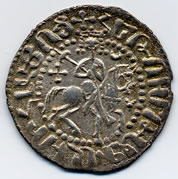
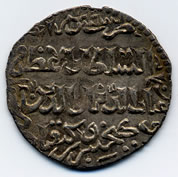
Kingdom of Cilician or Lesser Armenia, Hethum I 1226-1270, AR Bilingual Tram acknowledging the Seljuk Sultan of Rum Kaykhusru II 1236-1245.
Lesser Armenia was set up by the Byzantines first as a principality, then a kingdom, to act as a buffer state against Moslem advances into Anatolia. When the last Roupenid king died in 1219, he left his daughter Zabel as monarch, married to Philip, son of the crusader Prince of Antioch. Philip proved unpopular and was deposed and killed in 1225, and Zabel was married to Hethum of Barberon and they became joint monarchs in 1226. Antioch was unhappy at Philip's removal, but prevented from direct attack by order of the Pope, they urged the Sultan of Rum, Kaykobad to invade Armenia. Hethum settled the matter by acknowleging Kaykobad, then his successor Kaykhusru, as overlord. With the coming of the Mongols, in 1247, Hethum submitted to Khan Güyük. The alliance with the Mongols proved useful in resisting first Seljuk, then Mamluk advances. In 1270 Hethum abdicated in favour of his son Levon II and retired to a monastery to live out his last days as a monk.
Photos © Angela Grant 2010-2019
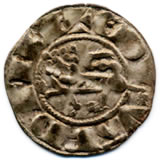
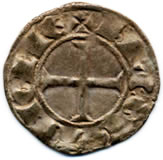
Duchy of Aquitaine, AR Denier au Lion, in the name of 'Edward son of Henry, King of England'.
Edward was granted the Duchy by his father, Henry III, in 1249 but he received no income from it since Simon de Montfort was effective ruler and diverted the revenue to his own purposes. It was not until Simon returned to England in 1261, and was finally defeated in 1265, that Edward had any income from there. These coins were probably issued between 1265 and Henry's death in 1272, when Edward became Edward I of England.
Photos © Angela Grant 2015
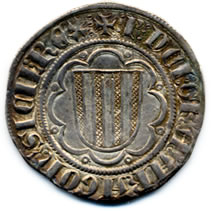
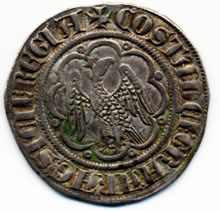
Kingdom of Sicily, Peter I (III of Aragon), 1282-1285, AR Pierreale.
After the Sicilian Vespers of Easter Monday, 30 March 1282, when the inhabitants of Palermo rose up and slaughtered the hated French supporters of Charles of Anjou,
the Sicilians invited Pedro of Aragon, who was married to Constance, the heiress of the Hohenstaufen Kings of Sicily, to be their king.
On successfully occupying the island, the new king needed a coin to replace the Angevin Carlino.
The design of the Pierreale incorporates his titles and the red and gold shield of Aragon on one side, and Constance's titles and the black eagle of the Hohenstaufens on the other.
Photos © Angela Grant 2015
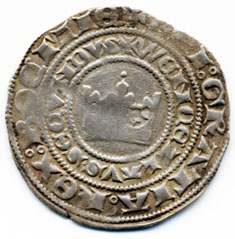
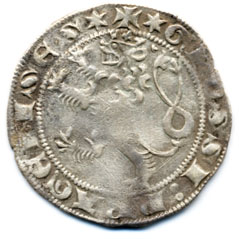
Kingdom of Bohemia, Wenceslaus (Václav) II, 1278-1305, Prague Groshen.
Wenceslaus II was born in 1271, the only surviving son of King Ottokar II of Bohemia and Ottokar's second wife Kunigunda of Slavonia. Ottokar ruled over lands from Bohemia down to the Adriatic, but lost them all except Bohemia and Moravia to the Habsburgs in 1276, and died in 1278. Wenceslaus succeeded under the Regency of Otto V, Margrave of Brandenburg, who is said to have held Wenceslaus captive in several locations. Wenceslaus returned to Bohemia in 1283, officially without Regent, but heavily influenced by his mother and her new partner, Záviš of Falkenstein. In 1285 Wenceslaus married Judith of Habsburg, and his mother Kunigunda died. In 1290, Wenceslaus had Záviš beheaded for treason. In 1298, silver was discovered in Kutná Hora (Kuttenberg), which Wenceslaus took over and this enabled the reform of the state coinage, and the production of the large Prague Groshen, in imitation of the French Gros. Because of the high silver content the coin became very popular in medieval central Europe. In 1300 Wenceslaus became King of Poland and married Elisabeth, a Polish princess, as Judith had died. In 1301 he took the crown of Hungary on behalf of his son, also called Wenceslaus. In 1305 he died and was succeeded by his son Wenceslaus III.
Photos © Angela Grant 2014-2015
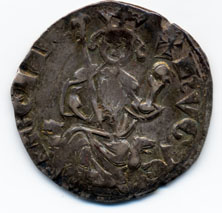
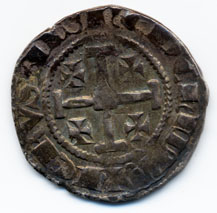
Kingdom of Cyprus, Hugh IV, 1324-1359, AR Gros Grand, 2nd series 'cross at throat' type, no field mark.
The son of Guy, Constable of Cyprus (son of Hugh III of Cyprus), and Eschiva of Ibelin, Hugh de Lusignan succeeded his father as Constable of Cyprus in 1318, and later succeeded to the throne of Cyprus on the death of his uncle Henry II, since Henry II had no son. He was also crowned as titular king of Jerusalem, but showed little interest in affairs outside Cyprus, and prevented his son Peter from raising a new crusade to regain the lost territory. He resigned the throne to Peter in 1358, and died the following year.
The reverse has the Cross of Jerusalem in the centre, and the inscription, continuous from obverse to reverse, describes him as 'Hugh King of Jerusalem and Cyprus'.
Photos © Angela Grant 2013-2017.
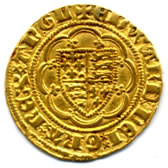
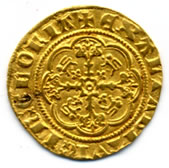
Kingdom of England, Edward III, 1327-1377, AV Quarter Noble, 4th coinage, Treaty Period (1363-9), Calais mint.
After the Death of Charles IV of France in 1328, Edward claimed the crown as closest male heir as Charles's nephew, but French jurists claimed the crown could not descend through the female line and crowned Philip VI instead. In 1337 Edward refused to pay homage to Philip for the Duchy of Aquitaine, and Philip confiscated the English lands in Gascony in retaliation, thus starting the Hundred Years' War. From 1340 to 1360 Edward claimed the title King of France, but relinquished it at the Treaty of Brétigny in exchange for substantial lands. In 1369 the French broke the treaty, and Edward resumed the use of the title, which his successors retained.
This coins was issued in the treaty period, and, therefore, does not retain the French titles, but still retains the blazon of France Ancient in the first and fourth quarters of the royal shield.
Calais was considered part of the realm of England and issued coins to the English standard, not the French. The only mark to distinguish this from coins struck at the Tower of London is the small annulet in the centre of the reverse. Calais remained in English hands until 1558.
Photos © Angela Grant 2004-2019.
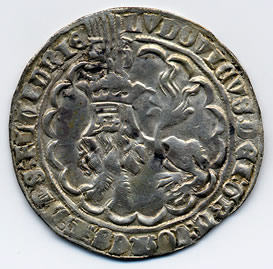
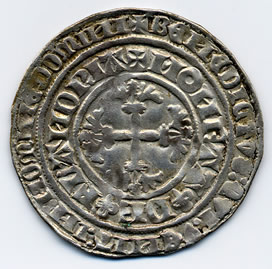
County of Flanders, Louis II de Male, 1346-1384, AR Botrager or Double Gros.
Last of the House of Dampierre, Louis II trod a careful course of neutrality between France and England, whilst gathering as much territory as he could. He inherited Flanders, Nevers, and Rethel on the death of his father fighting Edward III at Crécy. He married Margaret of Brabant, and, on the death of her father John III, assumed the title of Duke and attempted to take over the Duchy but was resisted by Margaret's sister Joanna. In the subsequent peace treaty he obtained the Lordship of Mechelen, and the City of Antwerp. On the death of his mother in 1382 he received the counties of Artois and Burgundy (Franche-Comté). He died in 1384 with his only child, his daughter Margaret III as heir. She was married to Philip the Bold, Duke of Burgundy, and the territories that Louis had gathered passed, with the exception of an area France decided had reverted to them, to form a large part of the Burgundian Netherlands.
Photos © Angela Grant 2010-2019