

The World of Islam
Here follows a selection of coins from the Islamic world. The time period covered is from the rise of Islam to the beginning of machine made coinage. The area is from Islamic Spain to the East Indies.
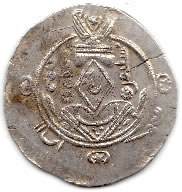
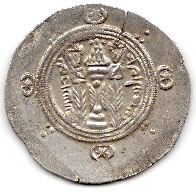
Tabaristan, Abbasid Governors, Sulayman ibn Musa, AH171–173/787–789CE, AR Hemidrachm or Tabari Dirhem, dated 137PYE.
Tabaristan, south of the Caspian Sea and separated from the rest of Iran by high mountains, was left behind as an independent enclave when the Arab conquest swept away the Sassanian Empire. It was ruled at first by a series of Ispahbads of the Dabwayhid family who, after the Arabs had discontinued the use of the Sassanian Drachm, produced their own coinage that was half the weight of, and of the style and portrait of the drachm issued by Khusru II. They dated the coins by the Post–Yazdigerd Era, that is from the date of the murder of the last Sassanian Emperor Yazdigerd III in 651CE. After the Arab conquest of Tabaristan in 761CE, the Abbasid governors continued the coinage and dating system, but the portrait became more and more debased as time passed. Sulayman alone followed the strict form of Islam and removed the emperor's head altogether from his coinage, replacing it with a diamond on which is inscribed the Arabic word 'bakh', meaning 'good'.
Photos © Angela Grant 2017.
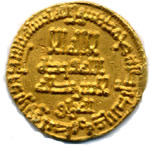
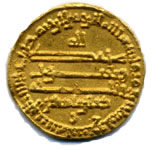
Abbasid Caliphate, AV Dinar, temp. al–Ma'mun, AH199/814–815CE, al–'Iraq, citing Dhu'l Ri'asatayn.
At the death of Harun Al–Rashid the Caliphate was disputed between his two sons al–Amin and al–Ma'mun.
Al-Ma'mun's power base was in Khorasan and he appointed al–Fadl ibn Sahl both as his vizier and his amir.
From this dual civil and military command was derived his epithet Dhu'l Ri'asatayn, 'the man of the two commands'.
This coin was minted in Mesopotamia the year after the defeat of al–Amin, whilst al–Fadl's army was presumably in occupation.
Photos © Angela Grant 2015


Sumatra, Sultanate of Samud(e)ra Pasai, Mohammed Malik al–Zahir, 1297–1326CE, AV Kupang.
The trading port of Pasai lies on the eastern side of the northernmost tip of Sumatra, facing the Malay Peninsula. It was ruled by a series of Sultans from the end of the thirteenth century CE until the beginning of the sixteenth century CE, when it was absorbed by the neighbouring sultanate of A(t)cheh. The coinage begun by the second sultan, Mohammed Malik al–Zahir, consisted of tiny gold Kupangs averaging 0.6 of a gram in weight. The coinage was continued by the Sultans of A(t)cheh.
Photos © Angela Grant 2015
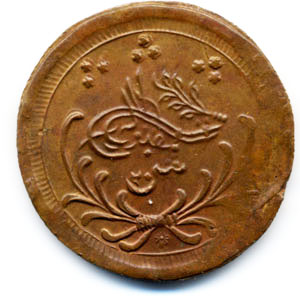
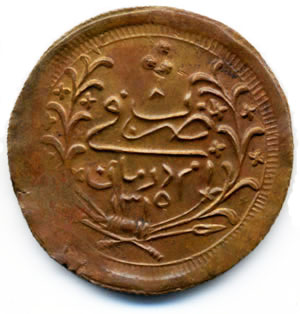
Sudan, 'Abd Allah ibn Mohammed al–Taaishi, Khalifat al-Mahdi (the Khalifa Abdullah), 1885–1898CE.
AE Twenty Piastres, Omdurman Mint, 1315AH (1897/8AD)
On the death of Mohammed Ahmad ibn 'Abd Allah al–Mahdi in 1885, 'Abd Allah was one of three successors appointed by al–Mahdi. However, he soon emerged as leader and altered the direction of the Mahdiyya to a jihadist state intent on expansion. His attack on Ethiopia was initially successful but, although a counter–attack by Yohannes IV resulted in the latter's death, there was a failure to follow through. An attack on Egypt was repulsed, and followed by an invasion by an Anglo–Egyptian force under Kitchener resulting in the death of 'Abd Allah, and the extinguishing of the Mahdiyya.
The state suffered from economic difficulties and the amount of silver in the coinage was gradually reduced until it was virtually nothing by the time this coin was issued.
Photos © Angela Grant 2014–15