

The Far East
Here follows a selection of coins from the Far East.
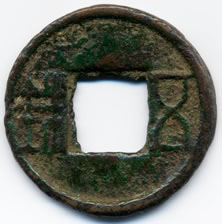
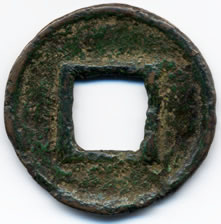
China, Western Han dynasty, AE Wu zhu.
These coins were introduced by the Western Han dynasty in 118BCE and continued to be minted and used for several hundred years after that, with the minor interruption of the numismatically interesting, but economically disastrous reign of the usurper Wang Mang (9–23 CE).
The coin name is an indication of the weight of the coin equalling five Zhu. The Chinese ounce or Liang (c. 16 grams) was divided into 24 zhu. This means the Wu zhu should weigh c.3.5 grams, but individual coins vary considerably. The example shown weighs 4.00 grams.
Photos © Angela Grant 2016.
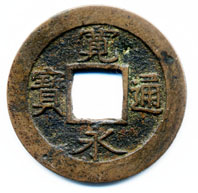
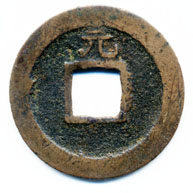
Japan, Tokugawa Shogunate, One Mon (Kan'ei Tsuho).
From medieval times until the end of the nineteenth century Japan was not ruled by the Emperors, who had little power, but by the Tokugawa Shoguns. These military leaders were extremely conservative to whom change was unwelcome. The Kan'ei era dated from 1624–1644CE, but, in fact, coins of this type were manufactured up to 1828CE, and are therefore difficult to date exactly. Coins with a blank reverse are the norm, and very common. Coins with a reverse character, in this case 'gen', are less common. Schjöth considered it to be a mintmark and attributed it to Osaka with a tentative date of 1741CE.
Photos © Angela Grant 2013–2015