

The Ancient World
Here follows a selection of coins from the ancient world. The area concerned is the Mediterranean basin and adjoining territories extending as far east as the borders of India. The time period covered is from the start of coinage in the west to the reform of Anastasius in 498AD.
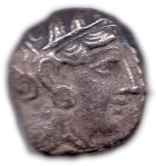
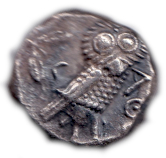
Athens, great recoinage of 353BCE, AR Tetradrachm, class Pi III(?).
In 353BC Athens made a rapid recoinage of its earlier silver by hammering it flat, folding it, and repeating the process, ending with a roughly triangular folded blank. The coin was then restruck using new dies.
Photos © Angela Grant 2026
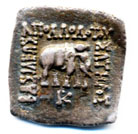
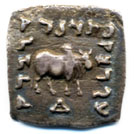
Indo-Greeks, Apollodotos I, c.180-160BCE or c.174-165BCE, AR Drachm, Indian standard.
Little is known of this king, or exactly over what territory he ruled, but his coins are found in Punjab, Sindh and Gujarat. Even the dates of his rule are a subject of argument. Coins of this type are particularly plentiful, and as the types of Greek coinage are generally religious in nature, it has been suggested that the elephant represents the white elephant that appeared in a dream to Queen Maya, the mother of Buddha, and the bull represents Nandi, the bull of Shiva, thus combining references to both Buddhism and Hinduism. The inscriptions are in Greek on one side and in Karosthi on the other. The meaning is the same on both: King Apollodotos the Saviour.
Photos © Angela Grant 2014-2015
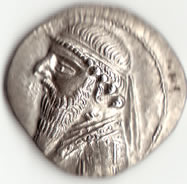
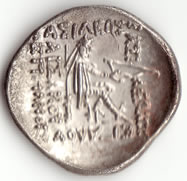
Parthian Empire, Mithradates II, the Great, 124-91BCE, AR Drachm, mint of Rhagae (Ray).
The reign of Mithradates was important for his consolidation and expansion of the empire. He conquered both Babylonia in the West and Sakastan in the east. The latter part of his reign was, however, troubled by a series of revolts, particularly that of Sinatruces.
Photos © Angela Grant 2020.
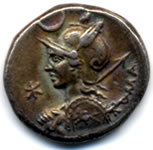
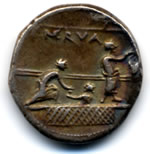
Roman Republic, P. Licinius Nerva, AR Denarius.
Nerva is listed as one of the Tresviri Monetales, the magistrates who controlled the production of coinage, for the year 113-112BCE.
As a propraetor he was assigned as Governor of Sicily in 104BCE at the outbreak of the Second Servile War which he unsuccessfully attempted to prevent.
The reverse shows voting in the comitium in Rome.
Photos © Angela Grant 2015
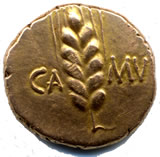
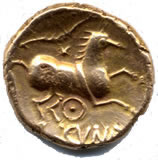
Ancient Britain, Trinovantes and Catuvellauni, Cunobelin, AV Stater, 'wild horse' type, mint of Camulodunum (Colchester).
Cunobelinos, son of Tasciovanos, ruled much of southern Britain between the end of the first century BCE and c.40CE.
The Welsh know him as Cynfelyn, and Shakespeare as Cymbeline.
He ruled the Trinovantes from Colchester, and the Catuvellauni from St Albans.
His son Caractacus (Welsh: Caradoc), by invading the territory of the Atrebates and ejecting their king, Verica, precipitated the Claudian invasion of 43AD.
Photos © Angela Grant 2005-2015.
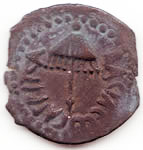
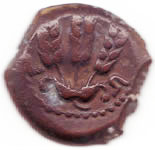
Kingdom of Judea, Herod Agrippa I, 37-44CE, AE Prutah.
Agrippa was the son of Aristobulus IV and Berenice, and grandson of Herod the Great. He was named in honour of the Roman statesman Marcus Vipsanius Agrippa. On the murder of his father he was sent to Rome by his grandfather, where he made an injudicious remark looking forward to Tiberius's death and the accession of Caligula, whereupon Tiberius had him thrown into prison. On Tiberius's death in 37AD Caligula had him released and gave him a chain of gold equal in weight to the iron chain he had in prison. Caligula granted him as a kingdom the territory that his uncle Philip the Tetrarch had held plus Abila. In 39AD, on the banishment of Herod Antipas, he was also granted Galilee and Peraea. For his help to Claudius in securing his accession after the murder of Caligula in 41AD, Agrippa was also granted Judea and Samaria. He began to refortify Jerusalem but did not finish because of Claudius's suspicions, which were also aroused by Agrippa courting his neighbouring rulers. After Passover in 44AD Agrippa went to Caesarea for games in honour of Claudius, where an owl perched above his head. This ill-omen quickly preceded his death, as recorded in the Acts of the Apostles, chapter 12.
Photos © Angela Grant 2017.
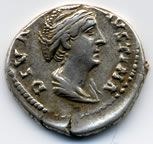
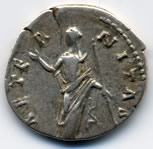
Rome, Faustina the Elder, died 140CE, AR Denarius
Faustina was the wife of Roman Emperor Antoninus Pius and was given the title Augusta on his accession in 138CE. She was highly respected in Rome and regarded as being of the highest moral virtue. She pre-deceased the emperor in AD140 and was deified by him. This resulted in the issue of coins in the name of "Diva Faustina", and the foundation of a charity in Rome in her name for orphaned girls.
Photos © Angela Grant 2009-2019
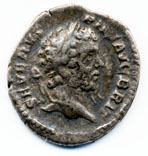
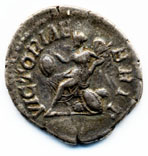
Roman Empire, Septimius Severus, 193-211CE, AR Denarius of 210-211CE, commemorating his expedition into Caledonia.
Severus landed with his army in 208CE, and proceeded north to strengthen Hadrian's Wall, recapture the area between that and the Antonine Wall, and to fortify that wall. He then took his army north into Caledonia, and, despite guerilla tactics by the Caledonians, in 210CE exacted an agreement from them agreeing that Rome should have control of the Central Lowlands. In the following year the Caledonians rose in revolt, and Severus planned a punitive expedition intending to slaughter as many as he could find. Before he got far, he fell seriously ill, withdrew south, and died in Eboracum (York). His son, Caracalla, continued the fight, but soon withdrew to the Antonine Wall. Not long after the Romans gave up the whole territory north of Hadrian's Wall, and never attempted an expedition into Caledonia again. A scarce coin.
Photos © Angela Grant 2013-2015
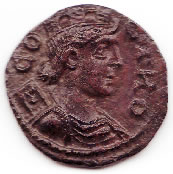
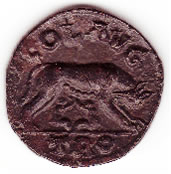
Roman Empire, Quasi-autonomous provincial coinage, Troas, Alexandria Troas, civic issue as colonia, 2nd-3rd Cent. CE, AE21.
Alexandria Troas was an ancient Greek city in north-western Asia Minor. Originally founded as Sigeia, it was refounded and enlarged in 306BC by Antigonus the One-Eyed of Macedon under the name of Antigonia Troas. In 301BC Antigonus renamed it Alexandria Troas in memory of Alexander the Great. In 188BC it was declared a 'free and autonomous city'. It prospered under the Romans and was made a Colonia by Augustus under the name of Colonia Alexandria Augusta Troas. Augustus, Hadrian, and Herod Atticus contributed to its embellishment, the latter giving it the aqueduct that still exists. Constantine the Great considered it as a possible site for his new capital, before deciding on Byzantium instead. It is unclear exactly when it was destroyed, but the remains cover some 990 acres with the walls clearly visible.
Photos © Angela Grant 2017.
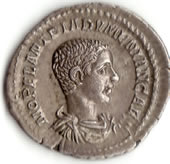
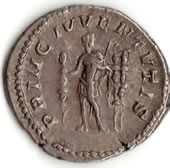
Rome, Diadumenian Caesar, 217-8CE, AR Denarius.
When Caracalla was assassinated Macrinus, the Praetorian Prefect, declared himself Augustus, and made his 8-year old son Diadumenian Caesar, and gave him the name Antoninus to indicate continuity with the Severan dynasty. Macrinus was of equestrian descent and all previous emperors had been from the senatorial class. This was resented. Caracalla's aunt Julia Maesa engineered a revolt in order to have her 14 year old grandson Bassianus made emperor. Macrinus was defeated at the battle of Antioch in 218 and Bassianus became the emperor Elagabalus. Macrinus sent Diadumenian with some trusted retainers to seek the protection of the last Parthian emperor Artabanus, but he was captured at Zeugma and beheaded. His head was sent to Elagabalus who kept it as a trophy.
Photos © Angela Grant 2020.
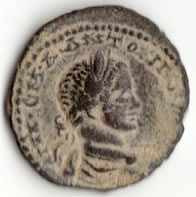
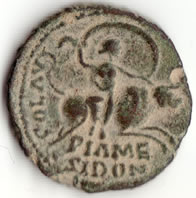
Rome, Elagabalus, 218-222CE, AE23, mint of Sidon in Phoenicia
On the assassination of Caracalla in 217, Macrinus, the Praetorian Prefect, was declared emperor, but Caracalla's aunt Julia Maesa engineered a revolt in order to have her 14 year old grandson Bassianus made emperor. Macrinus was defeated in 218 and Bassianus, who was priest of Elagabl, a meteoritic stone and the deity of Emesa, arrived in Rome with his god and took the name Marcus Aurelius Antoninus Augustus, claiming to be Caracalla's illegitimate son. Then began four years of debauchery and all manner of sexual excess before his grandmother had enough and arranged a plot to have him assassinated and replaced by his cousin Severus Alexander. The god Elagabl was sent back to Emesa.
Sidon was made a Roman Colony in his reign under the name of Colonia Aurelia Pia Metropolis Sidon and, in common with other colonies, used Latin rather than Greek inscriptions.
The reverse of the coin depicts Europa being carried off by the Bull.
Photos © Angela Grant 2020.
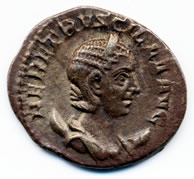
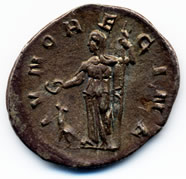
Roman Empire, Herennia Etruscilla (wife of Trajan Decius, and mother of Herennius Etruscus and Hostilian, 249-251CE), AR Antoninianus.
Very little is known about the wives of third century emperors, and Etruscilla is no exception. Her husband Decius came to power as the result of an army revolt against Philip the Arab. He is remembered chiefly for a persecution of Christians that arose because of their refusal to obey an edict demanding that they sacrifice to the gods to preserve the emperor and the state. An incursion of Goths into the Balkans caused him to lead an army against them accompanied by his son and joint emperor Herennius Etruscus. They were both killed at the Battle of Abritus, at which the Senate hailed his second son Hostilian as Augustus with Etruscilla as regent. The troops instead appointed Trebonianus Gallus, but Gallus accepted Hostilian as colleague, whilst nominating his own son Volusian as Caesar. Hostilian died of the plague later the same year, and Etruscilla appears to have retired into obscurity.
The crescent moon behind the bust indicates this is an Antoninianus, it being absent from the Denarius. This is equivalent to the emperors having a radiate crown on the Antoniniani and a laurel wreath on the Denarii. The Antoninianus was tariffed at two Denarii, though it only contained enough silver for 1.5 Denarii. The object to the left of Juno's feet on the reverse, is, of course, her peacock.
Photos © Angela Grant 2013-2019