

The Indian Sub–Continent
Here follows a selection of coins from the Indian Sub–Continent. The time period covered is from the start of punch–marked coinage to the beginning of machine made coinage.
Medieval India
Hindu Shahis of Kabul and Gandhara
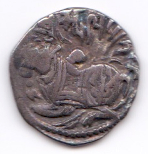
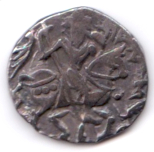
As I have a large collection of these coins I have moved the detailed information to a special page dedicated to the Hindus Shahis and post-Shahi imitations.
Gahadavalas of Kanauj
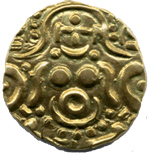
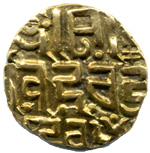
Gahadavalas of Kanauj and Kasi, Govinda Chandra, c.[1104] 1114–1154CE, base AV Lakshmi Stater.
The coins were minted in his lifetime and posthumously c. 1114–1154 CE. Assays have shown that the coins contain equal quantities of gold, the metal of the Sun and the lotus centre, silver, the metal of the Moon and lotus petals, and copper, the metal of fire and blood. Robert Tye, the expert on oriental numismatics, has rightly pointed out that the design of the Lakshmi staters of North India is actually a tromp d'oeil. Not only is it the figure of the beautiful Lakshmi, seated cross–legged on a lotus, but also the grinning face of Kali with her necklace of human skulls.
Photos © Angela Grant 2004
Yadavas of Devagiri
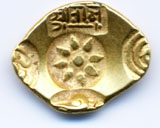
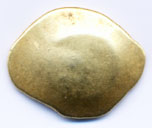
Yadavas (Seuna) of Devagiri, Ramachandra, 1271–1310CE, AV Padma Tanka.
Devagiri was the victim of the expansionist policies of the Delhi Sultanate. 'Ala ed–din Khalji captured the city in 1294CE, but allowed Ramachandra to remain in place for a substantial ransom and annual tribute. 'Ala ed–din sacked the royal treasury, and it is said on his return to Delhi he threw handfuls of these coins into the welcoming crowds. Ramachandra failed to pay the tribute, and, in 1307CE, a force under Malik Kafur captured Ramachandra, almost without resistance, and took him to Delhi. The king was again restored provided he helped 'Ala ed–din against the Hindu kingdoms further south. His successor Singhana III revolted against Delhi but was killed by Malik Kafur's army in 1313CE. The kingdom was annexed to the sultanate.
Photos © Angela Grant 2015
Modern Independent States
Punjab
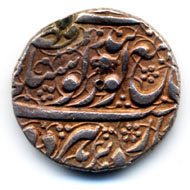
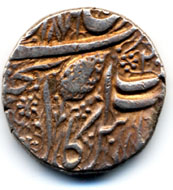
Punjab, Sikh Khalsa, temp. Ranjit Singh, 1801–1839CE, AR Nanakshahi Rupee, Amritsar Mint, 1876VS = 1819CE.
Ranjit Singh, the Lion of the Punjab, had a profound effect on the Sikh lands in the Punjab, unifying the various Sikh misl into one single empire in which all religions were given equal status. He also redesigned the coinage, making it of full weight and good silver and a pleasant appearance, with improved calligraphy and floral decoration. Ten years after his death the empire he created was gone, and the state carved up by the British.
Photos © Angela Grant 2014–2015