

Political Tokens
The Sedition Trials of 1793/4
The text of a talk given to the Oxford Numismatic Society in 1997, and, in a modified form, to the Oxford University Numismatic Society in 2011.
Political Tokens for General Sale
The Political Situation
London Corresponding Society
The Newgate Token
Daniel Isaac Eaton
Thomas Hardy
John Horne Tooke
Erskine & Gibbs
Conclusions
Sources
Political Tokens for General Sale
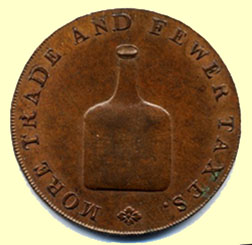
The political tokens of the eighteenth century come in many guises. Mostly they are unattributable and therefore irredeemable. Even where the issuer is known there are reasons why subsequent redemption might have been difficult as we shall see. Generally they come under the heading of tokens for general sale, that is pieces which were sold without issuer's name by the manufacturer at a discount to traders who required small change but didn't want the responsibility of later having to redeem them. In other words they were the sort of thing that got tokens a bad name. In addition to the normal they had a political message. Some were fairly straightforward such as this one:
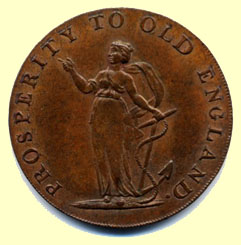
"More Trade and Fewer Taxes". Now nobody is going to argue with that. Exactly what the bottle is supposed to contain is not clear. There is a version of this token with the address of a Norwich saddler which is a genuine token but this one with a plain edge for general sale seems more common. Kempson was the issuer. The reverse says "Prosperity to Old England" with the figure of Hope. Prosperity for the manufacturers and issuers, no doubt, and the public were left with the hope that they might one day get their money back. Many tokens of this nature were issued. If you want something more patriotic how about this one:
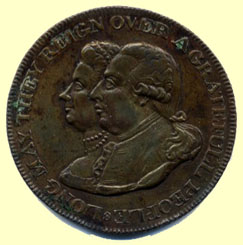
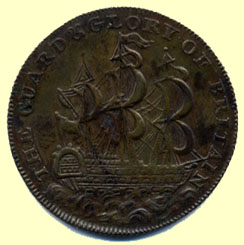
"Long May They Reign over a Grateful People" with the conjoined busts of George III & Queen Charlotte. The reverse: "The Guard & Glory of Britain" with a Man of War in full sail. The edge is plain. Here is another:
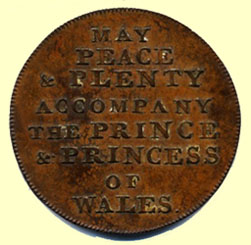
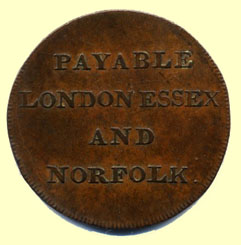
"May Peace & Plenty Accompany the Prince & Princess of Wales". This token makes an effort to appear redeemable: "Payable London Essex and Norfolk". Trouble is it doesn't say where. The Anti-French feeling of the time was also reflected in the tokens:
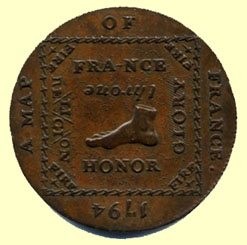
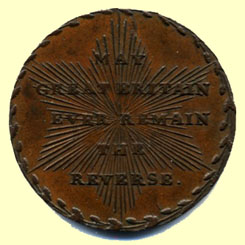
"A Map of France 1794". This picture story requires a little explanation. France is cut in two, and the throne turned upside down. Honour is trodden underfoot. Religion is hacked to pieces, and glory diminished (note the cross-hatching). There is fire in every corner, and the borders are surrounded by the daggers of assassins. "May Great Britain ever remain the reverse". Indeeed so! But these are not the type of political tokens I am here to talk about.
The Political Situation
Perhaps a brief description of the situation of the time would be helpful. I hope the historians amongst you will forgive any errors. Late eighteenth century Britain was a country in a state of some political unrest. The combined effects of population increase, the beginnings of the Industrial Revolution and the Revolutions in and subsequent wars with the American Colonies and France had sowed seeds of discord.
It must not be forgotten that the vote was limited to a very small section of the community by the property qualifications. Indeed even as late as just before the First Reform Act of 1832 it is estimated that the vote had only been given to 3.1% of the total population. Also representation was uneven as the Rotten Boroughs like Old Sarum were over–represented whilst important manufacturing areas such as Birmingham, Manchester and the West Riding of Yorkshire were heavily under-represented. There was no secret ballot and as each vote cast was afterwards published in a Poll Book the voter was subject to unfair pressures.
London Corresponding Society
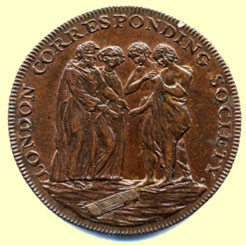
Unrest and calls for reform had been growing for years when the French revolution caused the establishment to start looking over their shoulders at the antics of its own home grown radicals. The main groups were societies such as the Friends of the People in Scotland and the Society for Promoting Constitutional Information (SCI) and the London Corresponding Society (LCS) in England. A token was issued on behalf of the LCS:
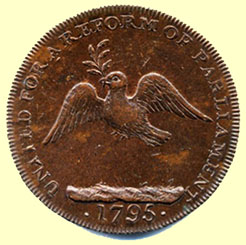
The obverse gives the name of the Society and an illustration of the Fable of the Sticks (one stick may be broken easily but many bound together cannot be broken). The reverse bears the inscription "United for a Reform of Parliament 1795" and a Dove of Peace indicating they wanted peaceful reform rather than Revolution. The diesinker is Jacobs and the issuer probably Skidmore. But I am running ahead of myself here as the token was issued after the end of the trials I am about to describe and possibly as a result of them.
In May of 1793 Charles Grey had introduced a Reform motion in parliament which had been supported by 36 petitions, two-thirds from Scotland, and none from the English Counties. The petition from the LCS contained no less than 5,000 signatures. Pitt described the proposal as 'capable of producing much mischief and likely to be attended with no good'. The motion was lost by 282 to 41. Reform of Parliament was thus considered dead as a matter of Parliamentary business for the foreseeable future.
The Newgate Token
Unrest continued which brings me to the next token:
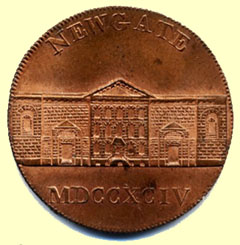
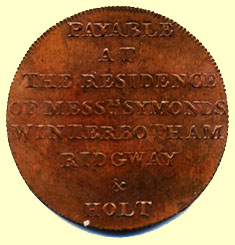
"Newgate 1794" with a rather splendid view of the front of the renowned prison of that name. The reverse: "Payable at the Residence of Messrs. Symonds, Winterbotham, Ridgway & Holt". The diesinker is T Wyon and the manufacturer Kempson. Now someone is having a little joke with us here. The four were indeed residents of the prison having been sent there as a result of series of convictions for sedition. Three of them for publishing. H. D. Symonds and James Ridgway for publishing Pigot's Female Jockey Club, the second part of Paine's Rights of Man and Paine's Letter Addressed to the Addressers. Daniel Holt, printer of the Newark Herald, for selling Paine's Address to the Addressers and publishing An Address to the Manufacturers of Unrepresented Towns, on a Parliamentary Reform. The second part of Paine's Rights of Man was considered more seditious than the first part because of its price. The first part was sold at about two guineas which restricted its sale to those few who could afford it but the second part was sold at less than a pound so bringing it within the grasp of the 'more common sort' and making it a dangerous book.
The Rev William Winterbotham was by far the most interesting of this quartet. Born in London, he was the son of a soldier in the Pretender's army. He was brought up by maternal grandparents in Cheltenham and apprenticed to a Silversmith. He set up his own business in 1784 but 'saw the light' and by December 1789 was a Baptist minister at How's Lane Chapel at Plymouth. On 5th November 1792 he preached a sermon on the Gunpowder Plot. His attitude to the monarchy was democratic in its nature and he referred to the aspects of the prevailing distress. Now feeling against the French Revolution was high in Plymouth at the time and Winterbotham had been involved in a dispute with the Corporation. He got to hear that there was talk of prosecuting him so he decided to put things right by preaching a second sermon on the French Revolution on 18th November 1792. Now I am afraid he severely misjudged his audience as far from improving matters it made them considerably worse. On 25 & 26th July 1793 he was tried at Exeter assizes for both sermons and found guilty. On 27th November he was sentenced to two years' imprisonment and a fine of £100 for each sermon. He was first sent to New Prison, Clerkenwell but conditions were so disgusting he successfully petitioned to be transferred and was sent to the state side of Newgate. He used his enforced idleness to write two books on the Chinese Empire and the United States, neither of which he appears to have visited. On his release on 27th November 1797 he married Mary Brend of Plymouth by whom he had four sons and two daughters. He returned to Plymouth but later transferred to Stroud and then Newmarket where he died on 31st March 1829.
Daniel Isaac Eaton
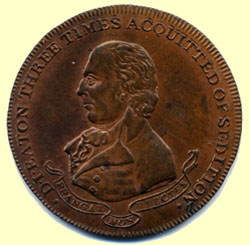
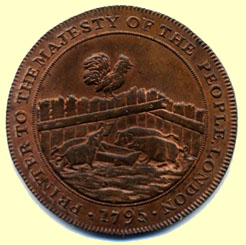
Here he is on his token with the inscription "Three Times Acquitted of Sedition" and the motto "Fracas Non Flectes". On 3rd June 1793 he was tried for selling the second part of Paine's Rights of Man and on 10th July following for selling Paine's Letter Addressed to the Addressers. On both occasions he was acquitted. The reverse says "Printer to the Majesty of the People London. 1795" around a cock on the fence of a pigsty in which the pigs appear to be consuming books. This refers to the fact that in 1794 he edited and published a periodical called Politics for the People or a Salmagundi for Swine. The swine are a reference to Burke's Reflections on the Revolution in France where he mentions that 'learning will be cast into the mire, and trodden down under the hoofs of a swinish multitude'. One issue contained a story about a game-cock for which he was prosecuted on 24th February 1794, the prosecution insisting that the game-cock referred to 'our lord the king'. Again he was acquitted. The token was issued from his shop "at the sign of the Cock and Swine" at 74 Newgate Street. The diesinker was Dixon and the manufacturer Good. He again came up before a special jury in 1795 for publishing Pigot's Female Jockey Club but the case was compromised by his counsel. He luck was not to last, however, for the next year he was tried twice, once for Pigot's Political Dictionary and once for the Duties of Citizenship. To escape punishment he quit the country, was outlawed, and lived in America for three and a half years. On his return his person and property were seized and he underwent fifteen months imprisonment. Books to the value of £2,800 packed for the American market were burnt on his premises. In 1811 he issued an edition of the first two parts of Paine's Age of Reason but on publishing the third and last part he was on trial again on 6th March 1812. He was again found guilty and sentenced to eighteen months imprisonment and to stand in the pillory when 'to the credit of the populace, instead of saluting him with what his prosecutors desired, they cheered, and even endeavoured to convey him some refreshment'. Someone published d'Holbach's Ecce Homo in his name in 1813 and he was again threatened with prosecution but escaped due to his advanced age. He died in poverty at his sister's house in Deptford on 22nd August 1814.
Thomas Hardy
Back to the history lesson. In Scotland matters had gone farther and the LCS and SCI received invitations to attend a British Convention in Edinburgh in November and December of 1793. The convention was run on French revolutionary lines and passed resolutions for annual Parliaments and proclaimed defiance to unconstitutional acts. The delegates of the LCS, Margarot and Gerrald played a major part and the affair stirred up feelings so much that they were arrested and eventually sentenced to transportation for fourteen years. This caused an outrage in England and far from stamping on the radicals it caused them to consider planning a new Convention for England. In April 1794 the LCS held an open air meeting at Chalk Farm by Primrose Hill to protest over the Scottish trials and the threats to liberty in England. An 'immense multitude' attended. The meeting ended with the resolution that any further attempts to 'violate those yet remaining laws' should be 'considered as dissolving entirely the social compact between the English Nation and their governors'. This, and the arrival of French spies to check for support in the event of an invasion, caused the Government to act.
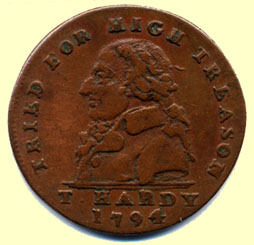
On 12th May 1794, Thomas Hardy, the Secretary of the LCS, was arrested in his shoemaker's shop in Piccadilly. Here he is on his token. Further arrests followed and after suspension of Habeas Corpus on 18th May and examinations by the Privy Council in June, and Grand Jury in Middlesex was directed in September to find that a charge of High Treason could be brought against twelve men including Hardy. On 28th October they brought in a true bill against all of them.
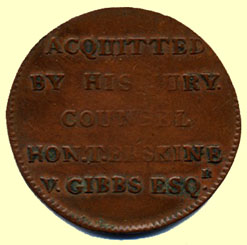
Hardy was a Scotsman, the son of a merchant seaman who died while he was still a child. He was brought up by his maternal grandfather, a shoemaker who apprenticed him in his own trade. He arrived in London in 1774 and soon found employment and a bride. In 1791 he set up on his own at 9 Piccadilly and soon took an active interest in politics. In January 1792 Hardy with a few friends set up the LCS. Hardy was appointed Secretary and Treasurer at its first meeting. After his arrest and examination by the Privy Council he was committed to the Tower on 29th May 1794. While a prisoner his wife died in child-bed on 27th August. Hardy was the first of the twelve to be tried on 28th October. The trial lasted eight days. Sir John Scott, the Attorney-General prosecuted and Erskine and Gibbs defended. The evidence for the prosecution soon broke down and the attorney-general's attempt to prove 'constructive treason' failed. Several defence witnesses confirmed Hardy's good sense and peaceable disposition. On 5th November the jury returned a verdict of not guilty. Hardy was paraded in triumph by coach through the principal streets of London. The reverse reads: "Acquitted by his jury. Counsel Hon. T. Erskine, V. Gibbs Esqr." His imprisonment and trial had lost him all his trade and left him virtually penniless but help from friends enabled him to restart his business in November 1794 at 36 Tavistock Street, Covent Garden. His fame brought him overwhelming business but eventually it eased off and he removed in 1797 to Fleet Street until he retired in 1815. He became a Freeman of the Cordwainer's Company and a liveryman of the Needlemaker's Company. He died in Pimlico on 11th October 1832 and was buried in Bunhill Fields.
John Horne Tooke
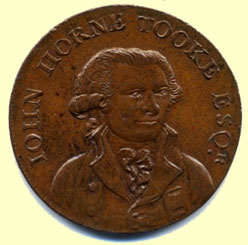
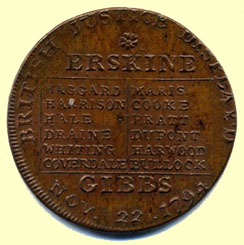
The next to be prosecuted was John Horne Tooke. Horne was the son of a Westminster poulterer. Well educated with both legal, clerical and medical training. In the 1760s he became a supporter of John Wilkes writing several pamphlets which narrowly escaped prosecution and taking part in several trials. In 1771 he had a spirited disagreement with Wilkes which lost him his political following. He resigned his church living and returned to legal wrangling. In 1774 he took the part of one William Tooke over an Enclosure Bill which was successfully opposed by somewhat unorthodox means. In 1775 he fell foul of the law by promoting a subscription for those killed by British troops at Lexington. He was convicted and sentenced to a fine of £200 and a year's imprisonment. He made several applications to the bar but was rejected every time which embittered him. In 1782 he added the name of Tooke to his own at William's request. It was assumed that this was to make him his heir but in end this was not the case. He joined the SCI when it was formed in 1780. Jeremiah Joyce sent a letter to him stating that 'Citizen Hardy' had been arrested, and asking 'Is it possible to be ready by Thursday?' The authorities seized the letter, took it to mean a rising, and arrested him on 16th May 1794. After Hardy's acquittal they were not taking chances and packed the jury. The trial started on 17th November. He was defended by Erskine & Gibbs but himself took a considerable part in the questioning of witnesses. He successfully proved that Joyce's letter referred to the publication of a list of sinecure places and not to a revolt. The prosecution collapsed and the jury took only eight minutes to return a verdict of not guilty. He took little part in further politics and retired to his home in Wimbledon. He was elected to Parliament in 1801, curiously for Old Sarum, which was then in the gift of Thomas Pitt, second Lord Camelford. He made some speeches against the ministry but was ejected in 1802 for being still technically in holy orders. He died at Wimbledon on 18th March 1812. The reverse reads: "British Justice Displayed. Nov 22nd 1794". The names of Erskine & Gibbs and the entire jury are given.
The next case brought to trial was that of John Thelwall on 1st December. The case against him was stronger and the jury was out for two hours but again brought in a verdict of not guilty. The testimony as to Thelwall's moral character was exceptionally strong, and his acquittal was the signal for a great outburst of applause. In mid December the Government dropped the rest of the prosecutions. There is a token of Thelwall relating to the trial similar to Hardy's but I have not been able to find an example of it. In 1795/6 Thomas Spence issued a series of tokens with Thelwall's bust on one side with a number of reverses. Spence was very fond of issuing short runs of mix & match dies aimed at collectors of the series, so all of these are rare.
Erskine & Gibbs
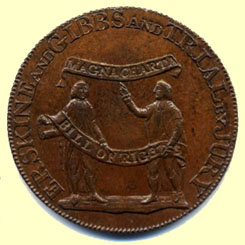
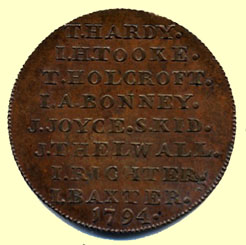
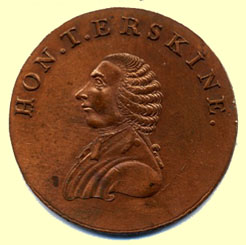
I have mentioned Erskine & Gibbs several times and here they are on a token holding ribbons inscribed "Magna Carta" and "Bill of Rights". The Hon Thomas, later Lord Erskine had a brilliant legal career terminating in his appointment as Lord Chancellor. Vicary, later Sir Vicary Gibbs also had a brilliant career terminating as Chief Justice of the Common Pleas. He had a humourless, caustic manner which earned him the name of Vinegar Gibbs. The reverse contains the names of nine of the twelve defendants.
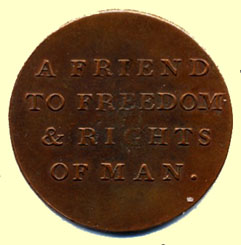
This one is of Erskine alone. The reverse: "A friend to freedom and the rights of man". Probably one of Spence's productions.
Conclusions
Tokens were originally produced in the eighteenth century as a means of countering the extreme shortage of small change. The few pieces shown here illustrate that they could also be used as a cheap means of getting political ideas over to the population in dangerous and changeable times. We are fortunate that the peak of the issue of tokens coincided with this particular series of political trials so that we are afforded to a glimpse into the attempts of the government to suppress dissent in a time of war; attempts that the general populace, as represented by the juries in these cases, desirous of reform, were determined to thwart.
Sources:
Dictionary of National Biography
Bell, R.C., Commercial Coins 1787–1804, Corbitt & Hunter 1963.
Mathias, P., English Trade Tokens, The Industrial Revolution Illustrated, Abelard-Schuman 1962.
Original Text: © K.P. Church, 1997.
Edited Text and Photos: © Angela Grant 2004 – 2011.